
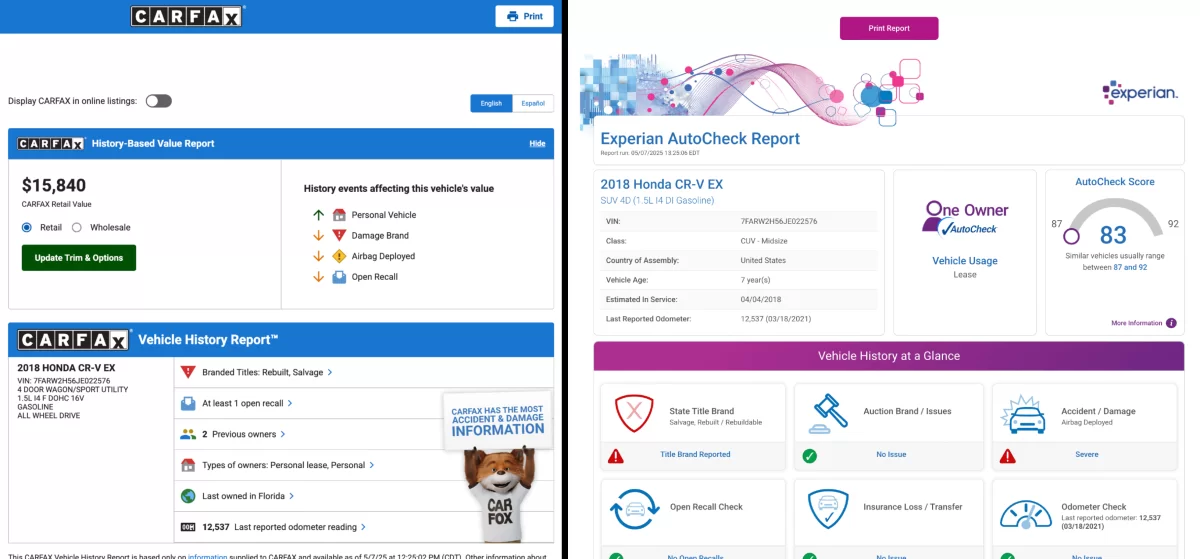
Embarking on the journey of buying a used car often brings a mix of excitement and apprehension. You might find a vehicle that appears perfect on the surface—gleaming paint, a smooth test drive, and a price that fits your budget—but a crucial question always looms: what hidden history might it conceal? This is precisely where Vehicle History Reports (VHRs) from industry leaders like Carfax and AutoCheck become indispensable. These reports serve as a vital lens into a car's past, potentially uncovering critical information about its accident history, title status, maintenance, and more.[10, 11] However, with two major providers in this field, prospective buyers often wonder about the difference between Carfax and AutoCheck, and ultimately, is Carfax or AutoCheck better suited to help you make a confident purchase?
This comprehensive guide will meticulously dissect the structure, content, and nuances of both Carfax and AutoCheck reports. We will explore each section in detail, explain the type of information provided—including a thorough look at the AutoCheck score explained—and compare their respective strengths and weaknesses. Our goal is to equip you with the knowledge to make an informed decision and select the VHR that best supports your used car purchasing journey.
The Foundation: What Vehicle History Reports Reveal and Why They Matter
Before we embark on a section-by-section comparison of Carfax and AutoCheck, it's essential to grasp the fundamental purpose and scope of Vehicle History Reports. Both services aim to provide a detailed chronicle of a vehicle's life, compiled by gathering data from its unique 17-digit Vehicle Identification Number (VIN). Essentially, a VHR serves as a background check for a car, aggregating information from a vast network of sources. These sources typically include State Departments of Motor Vehicles (DMVs), insurance companies, law enforcement agencies, auto auctions, repair and service facilities, and fleet management companies.
The critical value of these reports lies in their ability to unearth potential red flags that might be invisible during a standard visual inspection or test drive.[12, 13] Key information commonly found in both reports includes accident history, title issues (such as salvage, flood, or lemon designations), odometer readings (checking for potential fraud), ownership history, reported service records, previous usage patterns (like rental or fleet use), and open safety recalls. By obtaining and carefully reviewing a VHR, you equip yourself to mitigate risks, verify claims made by the seller, and approach your purchase decision with greater confidence and clarity.[10, 13, 11]
Deconstructing the Carfax Report: A Section-by-Section Analysis
Carfax reports have earned a strong reputation, often lauded for their detailed information and consumer-friendly presentation.[14] Understanding each section is key to leveraging the report effectively.
1. History-Based Value: Often one of the first pieces of information presented, the Carfax History-Based Value provides an estimated market value for the specific vehicle, uniquely adjusted based on its documented past. This differs from standard valuation tools that might primarily rely on make, model, year, mileage, and general condition. Carfax integrates factors such as the number of previous owners, reported accident history, the thoroughness of service records, any title issues (like salvage, flood, or lemon brands), and open recalls to offer a more nuanced valuation that reflects the actual historical data contained within the report.
2. Vehicle Overview: This section acts as an executive summary, providing a quick snapshot of the vehicle's fundamental details and key historical highlights. Here, you'll typically find the vehicle's basic specifications, including its year, make, model, trim level, VIN, body style, and powertrain information. It also summarizes critical historical points such as the number of owners, the type of reported usage (personal, rental, commercial), the last reported mileage, and a general indication of any reported damage. This overview is designed to give the reader an immediate high-level understanding, flagging potential areas of concern before they delve into the more granular details found later in the report.
3. Ownership History: This part of the report meticulously chronicles the vehicle's ownership timeline. Key data points include the year each owner purchased the vehicle, the duration of each ownership period, the state(s) where the vehicle was registered and titled, an estimation of the miles driven per year by each owner, and the type of use reported (e.g., personal, lease, corporate, rental, or even taxi/police use). A history showing multiple owners over a relatively short timeframe, or registrations in diverse and harsh climates (such as rust-belt states or coastal areas with salt exposure), might be indicators that warrant more thorough investigation and consideration.[15, 16, 17]
4. Title History: This is arguably one of the most critical sections of a Carfax report, as it flags potentially severe issues related to the vehicle's legal title status. Carfax diligently checks for various "branded" titles, which are official designations by state motor vehicle agencies indicating significant past problems. Common title brands include Salvage (indicating the vehicle was declared a total loss by an insurance company, likely due to extensive damage), Junk, Rebuilt/Reconstructed (a salvaged vehicle that has been repaired and passed inspection to be roadworthy again, though often with lingering concerns), Fire Damage, Flood Damage, Hail Damage [15], Lemon (a vehicle bought back by the manufacturer due to recurring, unfixable defects), and various Odometer-related brands (such as Not Actual Miles, Exceeds Mechanical Limits, or Potential Rollback). The presence of a branded title can significantly diminish a vehicle's market value, affect its insurability, and often signals severe past incidents that could compromise its long-term safety and reliability. Carfax often provides a "Buyback Guarantee" if their report fails to identify certain severe title brands that were officially recorded prior to the report date.
5. Additional History (Accidents, Damage, Recalls, Warranty): This section consolidates other significant events and statuses relevant to the vehicle's history. The Accident/Damage portion details reported collisions, instances of airbag deployment, findings of structural damage, and whether the vehicle was ever declared a total loss. Carfax often includes a damage severity scale (e.g., minor, moderate, severe) and may use a vehicle diagram to pinpoint the area of impact. The term "Other Damage" can refer to non-collision incidents like hail, vandalism, or accidents that were reported without an official police record. This section also lists any open manufacturer safety recalls that require attention and may indicate if any portion of the original factory warranty coverage is still active.
6. Detailed History: This is the most comprehensive part of the Carfax report, presenting a chronological log of reported events throughout the vehicle's operational life, integrating data from a multitude of sources. Entries can include initial pre-delivery inspections at new-car dealerships, subsequent sales and purchases, detailed accident reports (often with dates, locations, and severity assessments), title transfers [18, 19], odometer readings recorded at various events (like service visits or inspections), results from emissions and safety tests, and even reported lien information indicating outstanding loans. The level of detail, especially concerning service records (such as oil changes, tire rotations, brake work, and system inspections), is heavily dependent on whether the servicing facilities consistently report their data to Carfax.
Deconstructing the AutoCheck Report: A Section-by-Section Analysis
AutoCheck, a service provided by the global information services company Experian, offers a comparable vehicle history report but with some unique features and a distinct presentation style. Understanding its structure is key to interpreting its findings.
1. AutoCheck Score & Vehicle Comparison: This is AutoCheck's hallmark feature. The report prominently displays a numerical AutoCheck Score, typically on a scale of 1 to 100 (though the exact range can vary by vehicle class), which aims to predict the vehicle's likelihood of remaining operational in five years.[20, 21, 17, 22, 23, 24] More importantly, this score is presented alongside a Score Range, which shows the typical scores for vehicles of a similar make, model, year, and class. A vehicle scoring below its expected range may warrant caution, even if the numerical score itself seems relatively high. The score is calculated based on factors such as the vehicle's age, reported mileage, number of owners (with less impact noted for vehicles under 8 years old [25]), vehicle class, presence of title brands, reported accidents, odometer issues, frame damage, specific types of usage (like police or taxi use, which tend to lower the score, while rental use has little impact [20, 25, 21, 17, 22, 23, 24]), and other significant reported events.[20, 25, 21, 17, 22, 23, 24]
2. Vehicle History at a Glance (Overview/Summary): Similar in function to Carfax's overview, this section provides a quick summary of checks across major historical categories. It typically uses a clear "Problem Found" or "No Problem Found" indicator for key areas such as State Title Brands (like Salvage, Flood, Lemon), Auction-Announced Issues (which can include frame damage or odometer problems disclosed at auction), Accident/Damage events, Insurance Loss or Title Transfers to insurance companies, Odometer discrepancies, and other significant history points like liens or theft reports.
3. Accident Check / Damage Check: This area provides more detail on any reported accidents or damage.[1, 2, 3, 4, 5, 6, 7, 8, 9] Information can come from police reports, insurance claims, salvage auctions, or recycler records.[4, 6, 7, 8, 9] It may include details on the severity of the damage (e.g., minor, moderate, severe), as well as point of impact details, or airbag deployment information if reported.[26, 22, 23, 24, 27] AutoCheck often emphasizes its exclusive auction announcements regarding damage, which can be a key differentiator.[28, 26, 22, 23, 24, 27]
4. Title Brand Check: This section is dedicated to identifying state-issued title brands, which are official designations intended to warn potential buyers about significant past issues with a vehicle. AutoCheck screens for a comprehensive list of brands, including Fire, Hail, Flood, Junk/Scrapped, Lemon, Salvage, Rebuilt/Rebuildable, and various Odometer-related brands (such as Not Actual Miles, Broken Odometer, Exceeds Mechanical Limits, or Mileage Discrepancy). Like Carfax, AutoCheck also offers a form of Buyback Protection for certain qualifying vehicles if specific severe title brands were missed on the report.
5. Odometer Check: This part of the report details any reported issues or inconsistencies with the vehicle's odometer readings. It flags reported rollbacks, rollovers, or evidence of tampering that has been recorded by DMVs or at auctions. AutoCheck also states that it examines the sequence of reported odometer readings to identify potential discrepancies over time.
6. Vehicle Use and Event Check / Additional History: This section covers how the vehicle was utilized throughout its life and other notable reported events that may not fall under standard title brands or accident reports. It checks for various usage types, including Rental, Fleet, Lease, Taxi, Police, Government, or Commercial use.[20, 21, 26, 17, 29, 22, 30, 31, 23, 32, 24] Additionally, it flags other events such as Abandoned status, Grey Market import status (indicating a vehicle not originally built for the US market), active Liens, Repossessions, Theft reports, instances of Corrected or Duplicate Titles, and registration in known storm-affected areas.
7. Detailed History / Full History: Similar in function to Carfax's detailed log, this section provides a chronological listing of all reported events associated with the VIN. Each entry typically includes the date of the event, the location, the odometer reading at the time (if applicable), the source of the data (e.g., DMV, Dealer Record, Auto Auction, Police Report), and specific details about the event itself. This can integrate information on title transfers, registration renewals, auction events (including announcements like "Fleet/Lease" or "Frame Damage" [32]), accident reports, service records (though often less detailed than Carfax), inspections, and more.
Head-to-Head Comparison: Key Differences by Section
Having explored the individual components of each report, a direct comparison highlights their distinct approaches and strengths in specific areas:
Scoring/Valuation: The most apparent difference lies here. AutoCheck features its proprietary AutoCheck Score, a numerical rating designed to offer a quick comparative assessment of a vehicle's history against its peers. This score, when read with its accompanying range, aims to predict reliability. Carfax, on the other hand, provides a History-Based Value, which estimates the vehicle's current market worth, adjusted for events documented in its history, such as accidents or service records. AutoCheck focuses on a predictive reliability metric, while Carfax emphasizes the monetary impact of the vehicle's past.
Accident Reporting Detail: Both services report accidents, but their emphasis and detail can vary. Carfax is often perceived as providing more granular information on accident severity (using terms like minor, moderate, or severe) and frequently includes diagrams indicating the point of impact on the vehicle. Some sources suggest Carfax may also capture more recent accident data more quickly.[14, 33] AutoCheck also reports accidents and may include severity or impact details if provided by their data source, but it is particularly noted for its strength in reporting damage that was specifically announced at auto auctions, a detail that might be less consistently prominent in Carfax reports.
Maintenance/Service Records: This is another area of notable difference. Carfax is generally considered to have more extensive and detailed service and maintenance records, particularly from dealerships and participating repair shops. AutoCheck does include service records when they are reported to its network, but its coverage in this specific area is typically viewed as less comprehensive than Carfax's. For buyers prioritizing a detailed maintenance log, Carfax often holds an edge.
Auction Data: AutoCheck is widely recognized for its strong coverage of data from major U.S. auto auctions, such as Manheim and ADESA. This includes exclusive auction announcements regarding a vehicle's condition, such as disclosed frame damage or lemon law buybacks, which are critical for assessing vehicles sourced from the auction circuit. While Carfax also includes auction data, AutoCheck's emphasis and exclusive partnerships often give it an advantage in the depth and breadth of auction-specific information.
Ownership Count: There can be subtle differences in how ownership is counted. Some users and industry observers have noted that Carfax may sometimes count dealerships that take temporary possession of a vehicle (e.g., on trade-in before resale) as separate owners, which could potentially inflate the perceived number of owners compared to AutoCheck, which tends to focus more on individuals or entities that have formally registered the vehicle for use.[14, 33]
Reliability and the Inherent Limitations of VHRs
It is absolutely crucial for any used car buyer to understand that neither Carfax nor AutoCheck can provide a 100% infallible or complete history of every vehicle. The accuracy and comprehensiveness of these reports are entirely dependent on the data that is reported to them by their extensive networks of sources.
Several inherent limitations can lead to potential gaps or inaccuracies in any VHR:
Unreported Events: A significant amount of vehicle history may never be officially recorded. For example, accidents that are settled privately without involving police or insurance companies, or maintenance and repairs performed at independent, non-reporting shops or by the owner themselves (DIY repairs), will often not appear on either a Carfax or an AutoCheck report.[34, 35, 36, 15, 37, 16, 31, 32, 38]
Reporting Delays: Information isn't instantaneous. An accident or service event might take days, weeks, or even months to appear on a report.[34, 14, 39, 40, 41, 32] An accident that happened just last week, or even a few months ago, might not yet be reflected in the databases.
Data Errors: Mistakes can happen during the data entry process at the source (e.g., a typo at the DMV, an incorrect service code entered by a repair shop). Such errors can lead to inaccuracies in the reported history.[34, 39, 36, 42, 43, 41]
Source Discrepancies: Because Carfax and AutoCheck utilize slightly different, and in some cases exclusive, data sources and partnerships, it's not uncommon for one report to contain information that the other misses, and vice-versa.
The Critical Takeaway: Vehicle History Reports are invaluable screening tools that can help you identify many potential issues and make more informed decisions. However, they should never be considered a substitute for a thorough pre-purchase inspection (PPI) conducted by a qualified, independent mechanic. A skilled mechanic can physically inspect the vehicle for signs of hidden damage, previous poor quality repairs, mechanical wear and tear, and other issues that a paper report simply cannot reveal.[37, 16, 44]
Pricing Structures: Official Costs vs. The Carvins.net Advantage
The cost of obtaining VHRs can be a significant consideration, especially if you are evaluating multiple used cars. When purchasing directly from the primary providers, prices (which are subject to change) are typically in the following ranges:
Carfax: Approximately $44.99 for a single report. They also offer multi-report packages, such as three reports for approximately $64.99, or five/six reports for around $99.99, which lowers the per-report cost.[45, 46]
AutoCheck: Generally more affordable for single purchases, often priced around $24.99-$29.99.[47, 37, 48] They also offer multi-report packages, such as five reports (often valid for a 21-day period) for approximately $49.99-$59.99.[47, 37]
This is where Carvins.net offers exceptional value and a distinct advantage for savvy car shoppers. As an authorized reseller with trusted partnerships, Carvins.net provides the exact same official Carfax and AutoCheck reports but at a substantial discount. Typically, you can obtain:
- Single Reports (Carfax or AutoCheck): For approximately $7.50 - $8.50.
- Bundle (Carfax + AutoCheck): Often the best value, providing both reports for around $11.25 - $12.75.
- Credit Packs: For those needing multiple reports over time, credit packs offer even further bulk purchase savings.
This affordable access through Carvins.net makes it feasible to conduct thorough due diligence on multiple vehicles, or to obtain both Carfax and AutoCheck reports for a single vehicle you are seriously considering, without incurring the high costs associated with direct purchases.
Conclusion: Making the Right Choice for Your Peace of Mind
Ultimately, the question of is Carfax or AutoCheck better? doesn't have a one-size-fits-all answer. Both services provide valuable information, and the "better" choice often depends on your specific needs, priorities, and the particular vehicle you are researching.
Carfax might be your preferred choice if: You place a high value on potentially more detailed service and maintenance records, if strong consumer brand recognition is a factor for you, or if you are looking for potentially more granular details on reported accident severity and impact locations.
AutoCheck could be more advantageous if: You find its unique comparative AutoCheck Score particularly helpful for quick assessments, if you are investigating a vehicle with a likely auction history (due to AutoCheck's strong auction data reporting), or if you are looking for a slightly more budget-friendly option when purchasing directly from the provider.
For the most comprehensive insight and the greatest peace of mind, especially when making a significant investment like a used car, obtaining both a Carfax and an AutoCheck report is often the wisest strategy. This allows you to cross-reference information, potentially uncover discrepancies, and gain the broadest possible understanding of the vehicle's history. Thanks to the affordable bundles available through authorized resellers like Carvins.net, this thorough, dual-report approach is now more accessible and affordable than ever.
Don't let uncertainty overshadow your next used car purchase. Arm yourself with the detailed knowledge that Vehicle History Reports provide. Understand the nuances and the difference between Carfax and AutoCheck, and always remember to complement these reports with a professional pre-purchase inspection.
Ready to uncover the full story of your potential next car? Don't pay premium prices for essential information. Get your official, instant, and affordable Carfax report, AutoCheck report, or the best-value Carfax + AutoCheck bundle today at Carvins.net! Buy smarter, drive with greater confidence, and secure your peace of mind.


