
Confession time: I used to be that guy who bought Carfax reports like they were going out of style. Forty-five dollars here, forty-five dollars there - by the end of 2019, I'd spent more on vehicle history reports than I did on actual vehicle maintenance. My wife actually staged an intervention. There was a PowerPoint presentation. It was embarrassing.
But here's the thing - those reports saved me from some absolute disasters. Like the time I almost bought a "one-owner" Accord that turned out to have more previous owners than a library book. Or that Silverado that had apparently gone swimming during hurricane season.
These days, I get the same reports through carvins.net for five bucks (yes, I'm still amazed by this), but I've learned something important along the way: Carfax and AutoCheck aren't the same thing. They're like siblings - related, but with very different personalities. And depending on what car you're looking at, one might save your bacon while the other leaves you high and dry.
The Basics: What Are We Even Talking About?
Before we dive into the cage match, let me explain what these reports actually are for anyone who's new to this game (lucky you, learning this before spending hundreds on reports like yours truly).
Both Carfax and AutoCheck are vehicle history report services. They collect data from thousands of sources - DMVs, insurance companies, auto auctions, repair shops, and more - to create a timeline of a car's life. Think of it as a biography, but for cars, and way less interesting at parties.
The goal? To help you avoid buying a car that's been through more trauma than a soap opera character. Both services will tell you about accidents, title issues, service records, and ownership history. But HOW they tell you - and what they catch - can be very different.
The Carfax Experience: The Popular Kid
Carfax is like the iPhone of vehicle history reports - everyone knows it, most people use it, and it's got that slick marketing. "Show me the Carfax!" Yeah, that's them. They've been around since 1984, which in internet years makes them basically prehistoric.
What Carfax Does Well:
1. Service Records - This is where Carfax shines brighter than my bald spot under fluorescent lights. They have relationships with thousands of service centers, so if Jiffy Lube changed the oil, Carfax probably knows about it. I once pulled a report on a Camry that had every single oil change documented for 10 years. It was beautiful. I may have gotten emotional.
2. Accident Reporting - Carfax is really good at catching accidents, especially if insurance was involved. They'll tell you if airbags deployed, where the impact was, and sometimes even include a little diagram that looks like something from a crime scene investigation.
3. User-Friendly Reports - Even my technologically challenged uncle can read a Carfax report. They use nice graphics, clear language, and that green-yellow-red color coding that makes you feel like you're back in elementary school. Green = good, red = run away screaming.
Where Carfax Falls Short:
1. Auction Data - Carfax misses a lot of auction information. That car that's been through three auctions in six months? Carfax might show it as having one owner who "really liked to sell cars."
2. Price - If you're buying directly from Carfax, they want $44.99 for a single report. FORTY. FIVE. DOLLARS. For one report. On one car. It's highway robbery without the highway. (Thank god for carvins.net's $5 reports, or I'd be broke. Well, broker.)
3. Minor Incidents - Carfax sometimes misses smaller incidents that didn't involve insurance claims. That parking lot fender bender that got settled with cash? Ghost story as far as Carfax is concerned.
The AutoCheck Experience: The Overachiever's Choice
AutoCheck is owned by Experian (yes, the credit report people), and they take a different approach. Where Carfax is like your friend who tells stories, AutoCheck is like your friend who brings spreadsheets to lunch.
What AutoCheck Does Well:
1. The AutoCheck Score - This is brilliant and frustrating at the same time. They give each car a score (like 78 out of 100) based on its history compared to similar vehicles. It's like Yelp ratings for cars. A 2015 Accord with a score of 89? Pretty good. A score of 45? That car has seen some things.
2. Auction Coverage - AutoCheck is the king of auction data. They'll tell you every time that car crossed an auction block, which is crucial for spotting flippers and problem cars. I once saw a Civic that had been through seven auctions in two years. Seven! That's not a car, that's a hot potato.
3. Detailed Title Information - AutoCheck goes deep on title issues. They'll catch title brands that Carfax might miss, especially if the car moved between states. Remember that title-washing scam I wrote about? AutoCheck is better at catching those shenanigans.
Where AutoCheck Falls Short:
1. Service Records - This is AutoCheck's Achilles' heel. Where Carfax might show 20 service records, AutoCheck might show... three. Maybe. If you're lucky. It's like they're allergic to oil change receipts.
2. Report Readability - AutoCheck reports look like they were designed by someone who really loved Excel in the '90s. Lots of codes, abbreviations, and technical terms. First time I read one, I needed a decoder ring and a strong coffee.
3. Consumer Recognition - Try telling someone you have an AutoCheck report. They'll look at you like you said you have a report from your psychic. Everyone knows Carfax; AutoCheck is like the talented but unknown indie band of vehicle history.
Real-World Examples: When Each One Saved (Or Failed) Me
Let me tell you about two cars that perfectly illustrate the difference.
The Case of the Suspicious Suburban:
Found a 2016 Suburban on Facebook Marketplace. Price was good, seller seemed honest. Ran a Carfax - came back clean. One owner, no accidents, even showed regular oil changes at the dealer. I was ready to buy.
But something felt off (maybe it was the seller's nervous laugh when I asked about the suspension). So I splurged on an AutoCheck report too. BOOM - the car had been through four auctions in the last year, all listed as "frame damage" or "structural damage." The AutoCheck score? 34 out of 100.
Turns out the "one owner" had fixed it just enough to clear the official records but was flipping a seriously damaged truck. Carfax missed it completely; AutoCheck saved me from a $30,000 mistake.
The Mazda3 Maintenance Mystery:
Shopping for my sister (again - apparently I'm the family car consultant now), we found a 2017 Mazda3 with suspiciously low miles. AutoCheck showed it was clean - no accidents, clear title, decent score of 82.
But the Carfax report told a different story. This car had been serviced exactly twice in five years. Two oil changes in 60,000 miles. That engine had been more neglected than my gym membership. We passed, and my sister found a better-maintained one the next week.
Which One Should You Use? (The Million Dollar Question)
Here's where I'm supposed to declare a winner, right? But it's not that simple. It's like asking whether you should use a hammer or a screwdriver - depends on what you're trying to fix.
Use Carfax When:
- You're buying from a private seller
- Service history is crucial (like for high-maintenance European cars)
- You want the most user-friendly report
- The seller already has one (just verify it's real and recent)
Use AutoCheck When:
- You're buying from a dealer or auction
- The car might have been through multiple auctions
- You suspect title issues or state-hopping
- You want to compare the car's history to similar vehicles
The Smart Move? Use Both.
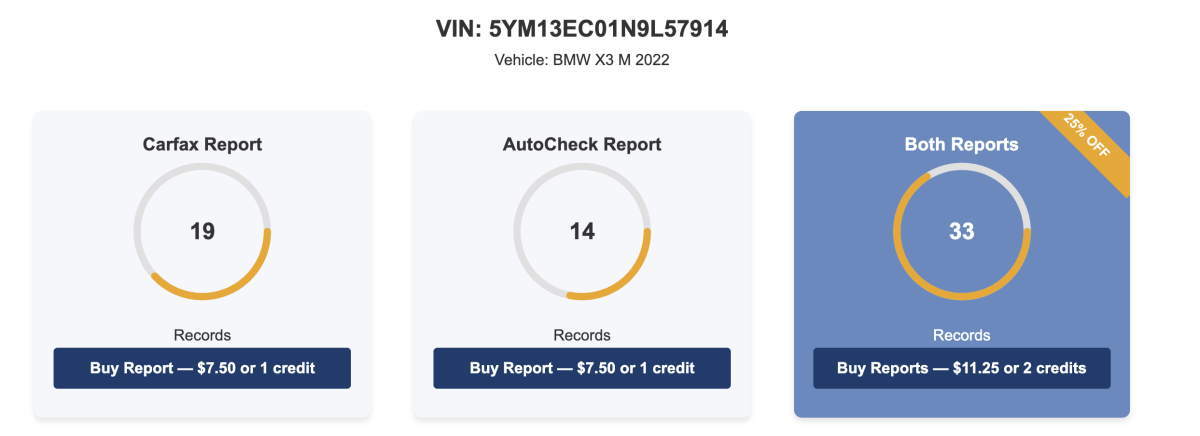
I know, I know. At retail prices, that would be like $90 for one car. But here's where I drop my favorite life hack: carvins.net gives you both Carfax AND AutoCheck reports for $5 each. Not $5 for both (I wish), but $5 per report instead of $45.
When I'm serious about a car, I run both. It's $10 total instead of $90, and the overlap helps verify information while each report's strengths cover the other's weaknesses. It's like having both a belt and suspenders - sure, it might be overkill, but your pants aren't falling down.
The Stuff Neither Report Will Tell You
Now, I'm not a mechanic, but... I've learned that these reports aren't magic. They won't tell you:
- If the owner drove it like they stole it
- Whether those "minor repairs" were done correctly
- If the car sat for two years in a field (unless it was reported stolen)
- That weird noise that only happens on Tuesdays
- Whether the previous owner vaped in it so much it smells like a candy factory
That's why these reports are just one tool in your arsenal. They're like a medical history - helpful, but you still need the physical exam (aka pre-purchase inspection).
My Vehicle History Report Strategy
After years of buying cars (and making expensive mistakes), here's my system:
1. Start with one report - Usually Carfax for private sales, AutoCheck for dealers
2. If anything seems weird, get the other report - Trust your gut
3. Cross-reference everything - If the stories don't match, dig deeper
4. Use the reports to negotiate - That accident Carfax found? That's money off the price
5. Save the reports - You'll need them when you sell
The Bottom Line: Knowledge Is Power (And Saves Money)
Look, whether you use Carfax, AutoCheck, or both, the important thing is that you use SOMETHING. Buying a used car without a history report is like going on a blind date with someone who "forgot" to mention their extensive criminal record.
Yes, I spent way too much money on these reports before discovering carvins.net (seriously, $5 instead of $45 still blows my mind). But even at full price, they would have been worth it for the disasters they helped me avoid.
The difference between Carfax and AutoCheck isn't about which one is "better" - it's about which one is better for your specific situation. Carfax is your friendly neighborhood storyteller, great with details and service records. AutoCheck is your analytical friend who catches patterns and auction shenanigans.
In a perfect world, you'd run both on every car you're serious about. In the real world, where we have budgets and coffee habits to support, pick the one that matches what you're buying. Or do what I do - use carvins.net, get both for less than the price of lunch, and sleep better knowing you've covered all your bases.
Because trust me, the only thing worse than spending money on vehicle history reports is NOT spending money on them and ending up with a car that's been underwater more times than a Navy submarine.
Stay smart out there, and remember - friends don't let friends buy cars without history reports. Even if those friends have to hear about how I used to pay $45 for them. Again.
- JT
P.S. - To that Suburban with the frame damage hiding from Carfax: I see you. AutoCheck sees you. You can't hide forever. And to the seller who tried to pass it off as "never been in an accident" - karma's got your license plate number, buddy.


