
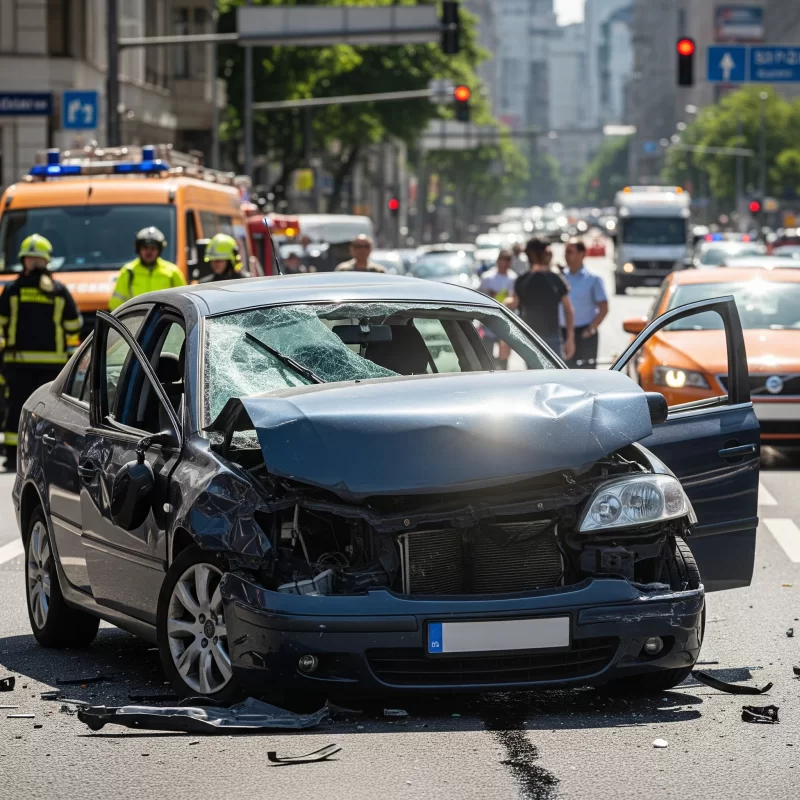
Alright, let's start with the big one. The absolute, no-questions-asked, deal-breaker stuff. The car's title is its legal identity.[1] A "clean" title is what you want. But sometimes, a title gets a "brand" on it, and that's the biggest, reddest flag you can possibly find.[2] These brands are warnings that the car has a dark past and might be unsafe.[3]
Let's break down the two most common ones you'll see: Salvage and Rebuilt.
- Salvage Title: A salvage title is like a doctor declaring a patient beyond saving. It means an insurance company looked at the car after a major accident, flood, or fire and said, "The cost to fix this thing is more than the car is even worth".[4, 5] So, they declared it a "total loss." A car with a salvage title is legally NOT roadworthy. You can't register it, you can't get plates for it, and you can't drive it on the street.[5] You're buying a pile of parts, not a daily driver.
- Rebuilt Title: A rebuilt title is like that same patient being brought back from the brink by a mad scientist. The car was salvaged, then someone bought it, patched it up, and got it to pass a state inspection to be deemed "roadworthy" again.[5, 6, 7] It's street-legal, but it will ALWAYS have that permanent scar on its record.
And it's not just those two. You might also see brands for "Flood Damage," "Fire Damage," or "Lemon Law Buyback".[8, 9, 10] A flood car is a rolling nightmare of electrical gremlins and hidden rust. A "Lemon" is a car the manufacturer had to buy back because it had so many factory defects they couldn't fix them.[11, 12]
Now, here's the DANGER, and I want you to listen close. While you can drive a car with a rebuilt title, the quality of those repairs is a GIANT question mark. State inspections can vary a lot, and some are just basic safety checks that might miss major underlying problems.[4] A car that's been in a wreck bad enough to total it might never be as safe as it was before, no matter how good it looks on the surface.[3, 13]
Buying a rebuilt car isn't just a safety gamble; it's a permanent financial headache. That cheap price tag isn't a simple discount. It's a trade-off for a lifetime of problems. Its resale value will always be drastically lower—often 20% to 40% less than a car with a clean title.[4] Many insurance companies will refuse to give you full coverage, and if they do, it might be more expensive because they see the car as a higher risk.[4, 5] And when it's your turn to sell it? Good luck. The pool of buyers willing to take that risk is tiny.[5] That "brand" on the title follows the car forever, impacting its value and insurability at every step.
Title Types at a Glance
| Title Type | Skid's Simple Definition | Can I Drive It Legally? | Insurance Headaches? | Skid's Bottom Line |
|---|---|---|---|---|
| Clean | The car has a normal history. This is what you want! | Yes | No | The gold standard. Proceed with your checks. |
| Salvage | Declared a "total loss" by insurance. It's legally junk. [2] | NO. Not roadworthy. [5] | You can't insure it for road use. | AVOID unless you're a pro mechanic looking for parts. |
| Rebuilt | Was salvaged, then fixed up and passed a state inspection. [6] | Yes | BIG TIME. May be hard to get full coverage. [4] | EXTREME caution. Value is shot and safety is a?. |
| Lemon | Manufacturer bought it back due to unfixable defects. [11] | Yes | Possibly. It has a known history of problems. | Why buy a car that was born with problems? Avoid. |
| Flood | Damaged by water. A rolling electrical nightmare. [9] | Maybe, if it gets a Rebuilt title. | Absolutely. Insurers hate flood cars. | Run away. Fast. Hidden rust and mold are no joke. |
Red Flag #2: Accident History - From Fender Benders to Frame Benders
Okay, so the title is clean. Great! But that doesn't mean the car has never been in a wreck. The VHR is your next stop to check for reported accidents.[14, 15] The key here is to understand that not all accidents are created equal. There's a world of difference between a shopping cart ding in a parking lot and a high-speed CRUNCH on the highway.
A good report will often give you details, sometimes even a little diagram showing where the impact was and how severe it was rated.[16, 17] Look for keywords like "airbag deployment".[2, 18] If the airbags went off, it was more than just a little tap.
What "Structural Damage" REALLY Means for You
This is the scariest phrase you can see in an accident report. If an accident report mentions "structural damage," I want you to pay VERY close attention. Think of it this way: cosmetic damage is like a cut on your skin. It's ugly, but it'll heal. Structural damage is a broken bone.[19, 20] It affects the car's actual skeleton—the frame or unibody chassis that everything is built on.[21, 22]
This is the most serious kind of damage because it compromises the core integrity of the vehicle. A car with structural damage, even if it's been "repaired," may not protect you as well in a future crash.[13] It can cause persistent problems with alignment, leading to uneven tire wear, and can make the car handle weirdly or feel unstable.[22, 23]
Here's the kicker: The VHR is not a foolproof bible of accidents. Its biggest limitation is that it only shows what's been reported.[10, 18] If someone smacks their car into a pole, panics, and pays their buddy cash to fix it in his garage without ever calling the police or their insurance company, it will NEVER show up on a Carfax report.[24, 25] A "clean" accident history doesn't guarantee an accident-free car.
This is why you can't just read the report and call it a day. You have to use it as an interrogation tool. If the report shows a minor accident on the passenger side, you ask the seller, "Hey, I see it was hit here. Can you show me the receipts for the repair work?" If the report is perfectly clean, you ask, "This looks great, but has the car ever had any paint or bodywork done at all?" Use the report to guide your questions and see if the seller's story matches the paper trail.
Red Flag #3: Ownership History - A Car's "Relationship" Status
A car's ownership history is a lot like a person's relationship history. One long, stable relationship is usually a good sign. A dozen short, chaotic flings in just a few years? That's a red flag.[8, 9] The VHR will show you how many people have owned the car, for how long, and even what kind of owner they were.[14, 16]
The "One-Owner" Gem
When you see "1 Owner" on a report, your ears should perk up. A one-owner car is often a fantastic find. Why? Because the story is simple. There's a much higher chance of a complete and consistent maintenance history because the records haven't been passed around and lost.[26, 27] The person who bought it new was likely invested in it, both financially and emotionally, and more inclined to keep up with proper maintenance.[27] It's not a guarantee, of course—you can have one very neglectful owner—but it dramatically simplifies your investigation. You have one story to check, not five. That's why one-owner cars often sell for a bit more; that peace of mind is worth something.[26, 28]
Multiple Owners and Rental Cars
On the flip side, seeing a car that's had four owners in five years should make you suspicious.[8] It could be a "problem car" that people keep buying and then dumping as soon as they discover the issue.[29] Each time it changes hands, the risk of neglected maintenance and lost records goes up.[26]
But the biggest caution sign in the ownership section is seeing that the car was used as a rental, fleet, or taxi vehicle.[2, 14] These cars live a hard life. They often have incredibly high mileage for their age.[30, 31] Think about it: they've been driven by hundreds of different people, many of whom probably drove it like they stole it because... well, it wasn't theirs.[32, 33] That means accelerated wear and tear on EVERYTHING—engine, transmission, brakes, suspension.[24, 33] While rental companies are usually good about routine oil changes, they're running a business. Minor accidents might get fixed cheaply in-house and never get reported, and they're not looking for subtle signs of abuse from that one guy who tried to take it off-roading.[24, 30]
Red Flag #4: The Paper Trail - Gaps, Lies, and Odometer Scams
This section of the report is where you put on your detective hat. You're looking at the service records and the odometer readings, trying to see if the story holds up.
Service History: The Car's Health Record
A detailed service history is like a clean bill of health from a doctor. Seeing regular oil changes, tire rotations, and records of major scheduled maintenance (like a timing belt replacement) is a HUGE confidence booster.[34, 35, 36] It shows the owner cared about the car and wasn't just trying to put off expensive work. A car with a well-documented service history is proven to be worth more money when it comes time to sell.[34, 37]
But what if there are gaps? A 30,000-mile gap between reported oil changes looks scary, but it doesn't automatically mean the car was neglected.[38] The owner might be a do-it-yourselfer who changes their own oil, or maybe they use a small local shop that doesn't report to Carfax.[18, 25] A gap isn't a death sentence, but it's a question you HAVE to ask. Ask the seller if they have paper receipts or any records to fill in those blanks.
Odometer Fraud: A Billion-Dollar Crime
This one is a MONSTER. Odometer fraud is when a criminal illegally rolls back the mileage on a car to make it look newer and less used than it is.[39] This is a federal crime, and it scams American car buyers out of more than a BILLION dollars every year.[39, 40] Digital odometers are actually EASIER to tamper with than the old mechanical ones, not harder. It's a huge problem and a lot of folks get taken for a ride, so you gotta be vigalent.
The VHR is your number one weapon against this scam. The report tracks the car's mileage every time it's officially seen—at state inspections, title transfers, service appointments, etc..[41, 42] You should see the mileage go up in a logical sequence over time.[2] If you EVER see a record where the mileage goes DOWN, that's it. Game over. RUN away from that car. Also, compare the mileage on the report to what's on the dashboard. And use your eyes! Does the wear and tear on the car match the mileage? If the odometer says 30,000 miles but the brake pedal is worn smooth and the driver's seat is torn up, your gut is telling you something is fishy.[39, 43]
The VHR Isn't the Whole Story: Your MOST Important Next Step
I've thrown a lot at you, but I need to make one thing crystal clear. A Vehicle History Report is an amazing tool, but it is NOT the final word. Think of it like an X-ray. An X-ray is fantastic for showing you a broken bone—like a salvage title—but it can't tell you if the patient has high blood pressure or a leaky heart valve. The VHR is just one tool in the diagnostic kit.[18, 44]
Your final, non-negotiable, absolutely-cannot-skip-it step is to get a Pre-Purchase Inspection (PPI).
A PPI is when you pay a qualified, independent mechanic—someone who isn't affiliated with the seller—to put the car up on a lift and give it a complete, professional examination.[1, 45] A good mechanic can spot the things a VHR will NEVER show you: evidence of shoddy accident repair, hidden rust, leaky gaskets, worn-out suspension parts, and the early signs of expensive engine or transmission problems.[46, 47] They'll check the mechanical, electrical, and structural systems from top to bottom.[48, 49]
And here's how you make that PPI even more powerful: don't just drop off the car. Hand the mechanic the Vehicle History Report. Say, "The report says it had a minor collision on the right front side and there's a 20,000-mile gap in the service records. Can you pay extra attention to the frame alignment in that area and check for any signs of deferred maintenance?" This turns a general inspection into a targeted investigation, using the VHR's clues to guide the mechanic's expert eyes.
And that brings me to the ultimate red flag. If a seller makes excuses, gets defensive, or flat-out refuses to let you take the car for an independent inspection... WALK AWAY. Don't even hesitate. A trustworthy seller with a good car has absolutely nothing to hide.[1]
Skid's Final Word from the Garage
Whew. Okay. Buying a used car is a big financial decision, but after reading this, you're not going in blind anymore. You know to check that title like a hawk, to question the accident and ownership history, and to look for any story that doesn't add up in the paper trail.
Remember, the VHR is your first line of defense, but that Pre-Purchase Inspection is your secret weapon. It's the best hundred bucks or so you'll ever spend when buying a car. Never, EVER skip the PPI.
Now you've got the knowledge. Go out there, be smart, ask the tough questions, and find yourself a great car you can trust for years to come.
Call to Action: Look, finding a solid used car can feel like a full-time job. If you want to skip some of the headache and look at cars that have already been given a good once-over by folks who know what they're doing, check out the inventory over at Carvins.net. They do a lot of the homework for you, which is a great place to start.


